
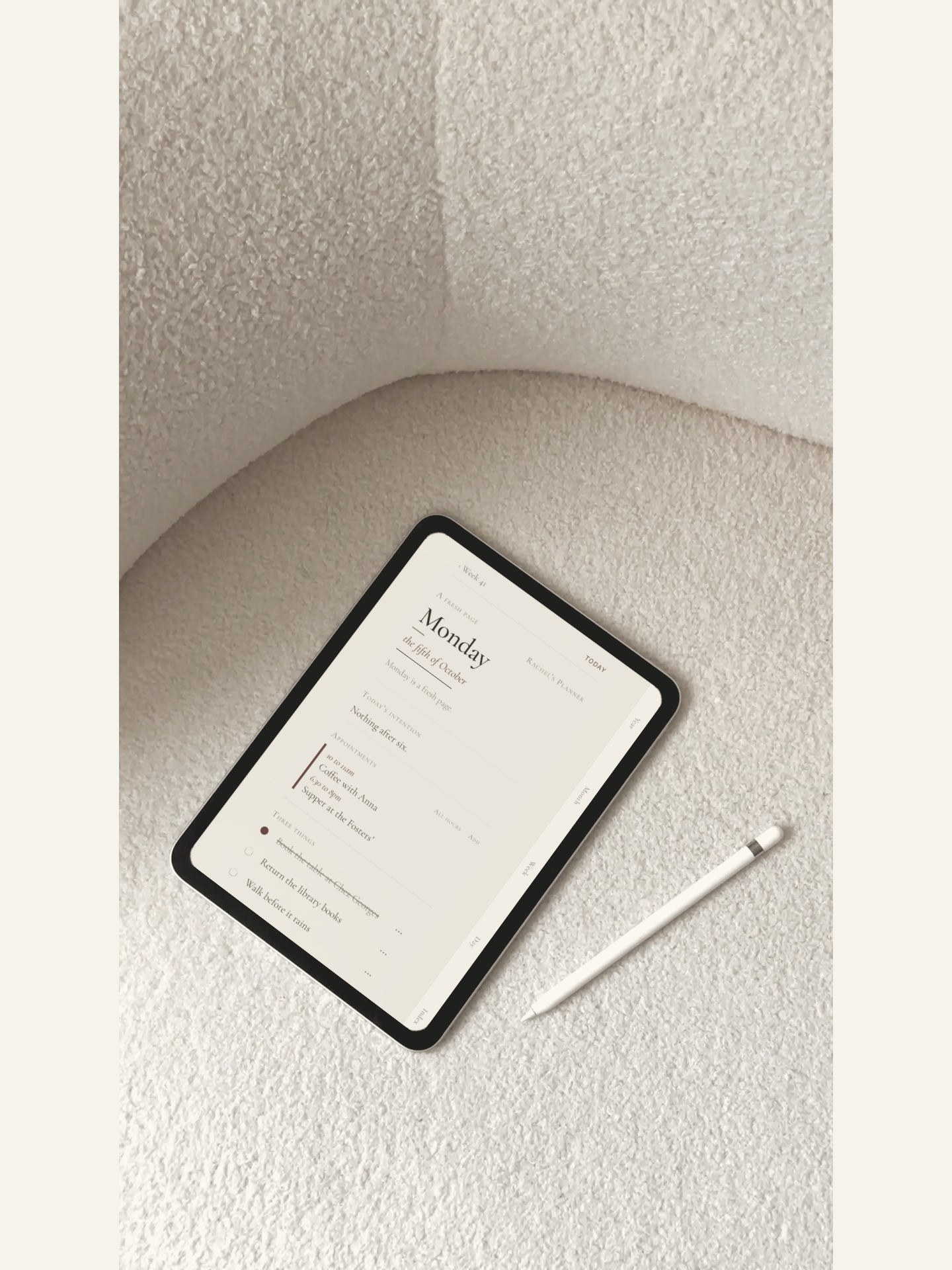
Miss a day
and nothing
is missed.
A planner you design · first edition, December
You are on the list.
We will write once, in December.
Eight questions, about a minute
It builds itself,
around you.
You are not handed a template to adapt to. You answer eight questions, your name, the year ahead, what each day should hold and watch the planner assemble underneath your answers.
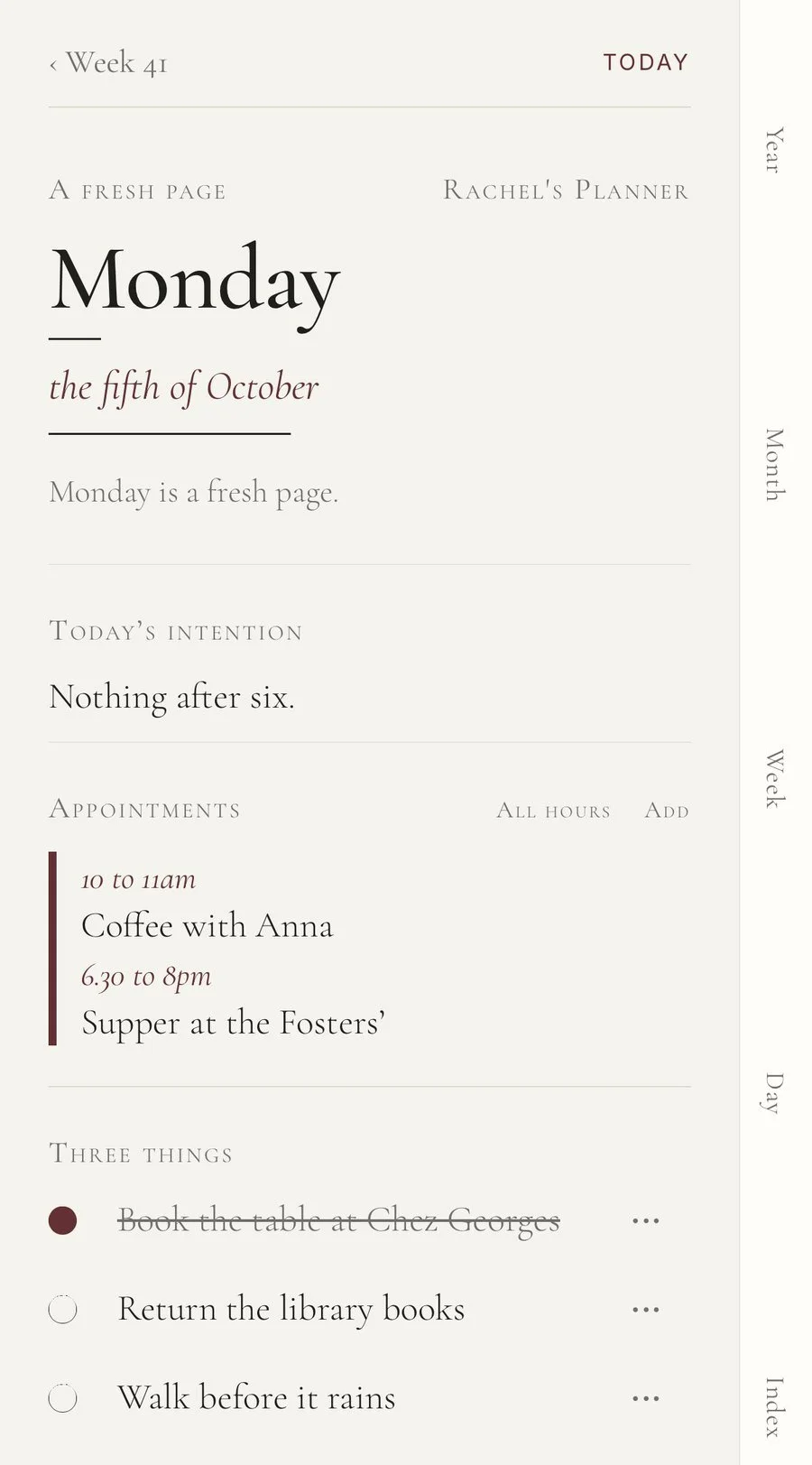
It lays out the day page with three things, appointments, an intention and the notes you chose, with habits, a quote and the list waiting to be added; the pages beyond it, goals, notes and letters, the shelf; and the finishes, your ink, your type, a cover drawn for it and your signature.
Everything can change later. Nothing has to. This is the page, as it is on the phone.

What it holds
Every day,
its own page.
Not a row, not a box, not a line in a grid. A whole page for a Tuesday and the same whole page for a Saturday, because in most diaries the weekend shares one small box at the foot of the week.
The Index is the planner's table of contents. What you chose is in it from the first day. Everything else waits there, greyed, until you want it and adding it costs nothing.
It turns with a swipe, the way paper does. Nothing here is a setting: every row is a page or a part of one.

A paper diary is about £25,
and you buy another one every January.
Lundi is £59,
once.
First edition, December · the first hundred pay £29, the next four hundred £39
Every January a new edition opens, last year goes on the shelf and you never buy it again. Nothing renews, nothing expires and there is nothing to cancel.
A share of every planner sold goes to an animal charity, chosen by a vote inside the app. There is more on that below.
The shelf
Yours for good.
Nothing expires in December. Each January a new edition opens and every year you have kept stays on the shelf, ready to be taken down.
Take one down.
For someone you love · from £39, once
Give a year.
A planner they design themselves, with their name on the cover and your note on the first page. It arrives on the morning you choose, in a parcel they unwrap. Theirs for good and never paid for again.
The card prints tonight. Or posted on ivory, or boxed with a real gold ribbon.
Two minutes to make. Nothing to wrap, nothing to post back.
Chosen by the people who use it
A share of it
goes to animals.
The planner is made of nothing. No leather, no paper, no box. So the money every other planner spends on all that goes to animals instead: a tenth of every one sold, every quarter, to a small rescue you vote for and never less than £100. Every receipt published.
Donkeys, hedgehogs, rescue greyhounds, marine life. Small enough that the money is felt and chosen by you rather than by us.
A note from the person who made it
Bourne End, September
Somewhere in your house there is a planner with eleven good days in it.
Mine was green. I bought it in a shop that smelled of paper, wrote in it beautifully until about the ninth of January, missed a week in February and never opened it again. Not because I was busy. Because the empty pages had become a record of having failed and nobody wants to read that.
I couldn't keep a paper one anyway. Holding it, carrying it, writing in it every day: my body doesn't do that reliably any more. So I went looking for a digital planner and found spreadsheets in nice fonts, apps that counted my streaks and templates that wanted me to learn a system before I could write down that I need to ring the dentist.
So I built the one I wanted.
It takes about a minute to make. You choose what it holds, how it reads, the paper, the cover and you sign it. Then it is yours, on your Home Screen and it stays yours. Every day gets its own page, Saturdays included. Miss a week and nothing turns red, nothing is counted, nothing is waiting to be explained. The next morning is a clean page, which is what Monday means and why it is called Lundi.
I'm not going to promise you a better year. I'm going to give you somewhere beautiful to put it and forgive you when you disappear for a while.
Lundi, first edition
Not in any other planner
The parts that
help you start.
Offered once, never nagged. Nothing here counts you.

The things people ask
Before you decide.
What happens after the first year?
A new edition opens in January with a new cover and last year becomes a spine on your shelf that you can open whenever you like. You never pay again.
Do I have to use all of it?
No. Most people run three or four things. Everything else sits greyed in the Index until you want it and can be taken away again.
Does it work on Android or a laptop?
Yes, in any modern browser. It is designed for iPhone and iPad first and the Apple Pencil writing is an iPad feature.
Can I write on it by hand?
Yes. Any day can have a blank space, plain or Seyès ruled. Seyès is the ruling of every French school exercise book: a line every eight millimetres with three fainter guide lines between and a margin in red. With the Pencil on iPad it has pressure and palm rejection.
What happens to what I have written?
It stays yours and it stays private. Only you can read your planner, you can export it and you can delete the lot in one action.
Is there a free version?
Not at launch. There is one price, paid once and if it is not for you within thirty days you can have your money back.
Can I give it as a present?
Yes. You write a note, choose the morning and they open a parcel and make their own. The card prints tonight or we post it. From £39, once. Give a year.
How do I get it on my phone?
On iPhone or iPad, open app.lundi.page in Safari, tap the share button, then Add to Home Screen. On Android, open it in Chrome and tap Install app. It opens from an icon like any other app, with no browser in sight. Nothing to download, nothing to update and no shop in between.
What does it connect to?
Google Calendar, read only and an Apple Calendar feed so Lundi's appointments can appear in yours. Bank holidays are added each year. Never your email, your contacts or your photos and nothing is ever written back.
The first edition
opens in December.
Join the list and you will hear before anyone else, at £29 rather than £59 and you will see it before it is finished.
You are on the list. We will write once, in December.